I have to say, I'm pretty proud of our most recent recycled glass and LED project. The first one was a good starting point for Jared and I to mess around with the glass etching and LED wiring.
This time, we aimed higher. We wanted to set LEDs in a wooden base and display the bottle on the base. A green bottle from some cheap red wine, a craft knife, electrical tape and etching cream led to this:
Because I didn't have a professional stencil, I covered the surface of the bottle with black tape where I wanted the design, then I carved out the shape of the tree with a craft knife. This method takes a steady hand and some concentration, but it is surprisingly forgiving because if you make a mistake (since you have to free-hand the design) you can remove the tape and try again.
For the base, we started with a plain wooden post cap from Home Depot, which we got on sale for $6.00. We drilled four holes in the top and covered it in a couple coats of wood stain.
Jared completed the next part, which was to drill a hole in one side for the jack and cord to plug in, and to drill another hole in another side to put in an on/off switch. Once those elements were in place, I helped solder the LEDs underneath the base.
Each LED has two tiny wires coming out of it, one which needs to be connected to the place power is coming from and the other that needs to be grounded. The photo was taken when only the wiring for the LED grounds were in place, so imagine the little wires doubled (to connect them to the power jack) and that would complete the wiring job.
The finished base looked like this from above. The on/off switch is on the opposite side.
Now the wine bottle had to be attached to the base, but glass is notoriously difficult to affix cleanly and solidly. We practiced using a couple of beer bottles and some plywood before discovering that carefully applied superglue held nicely and didn't interfere with the LEDs' glow coming up through the base.
I am certainly going to toot my own horn on this one: I think the lamp looks really good, considering we are amateurs who have limited experience with this sort of thing. Again, you could always use a wine bottle lamp kit to make something similar to recycle your old bottles. Look for bottles that have interesting shapes or colors to vary the style of lamp, too. You can also easily thread a strand of LED lights into a used bottle for a similar, yet simpler-to-achieve effect.
A smattering of thoughts for animal-lovers, Seattleites, word nerds, Celiacs, travelers, and probably your mom.
Showing posts with label Science. Show all posts
Sunday, July 3, 2011
Tuesday, March 29, 2011
Burke Museum and UW Seismology Lab
When my friend Alex said, "Wanna go on a field trip with my class?" I thought, "Like...as a chaperone?" But no, Alex's college geology class was taking a trip to visit the University of Washington's seismology lab as well as the nearby Burke Museum of Natural History and Culture, and guests were welcome. Always eager to participate in nerdy activities, I readily accepted the invitation.
We started our journey at the UW seismology lab, which looked a lot less like the international space station flight control room than I expected. Instead, all of the field trippers, amounting to about 20 students, wedged into the lab with only a tiny bit of breathing room.
The most advanced earthquake monitoring and recording equipment in the Northwest looks like this:
Even more interesting than (and approximately the same square footage as) the main lab was the seismology closet.
We visited the lab just a week before the 9.0 rocked Japan, so we weren't able to see any of those recordings, though they must have been absolutely incredible.
Alex and I unpacked ourselves from sardine-tin lab and walked across campus to our next stop, the Burke Museum.
Although the Burke is not an especially large museum, the use of space and quality of exhibits is exceptional. Alex's professor, who proved to be as knowledgeable about natural history as he is about geology, led us through the exhibits displaying dinosaur skeletons, fossils and other amazing prehistoric artifacts.
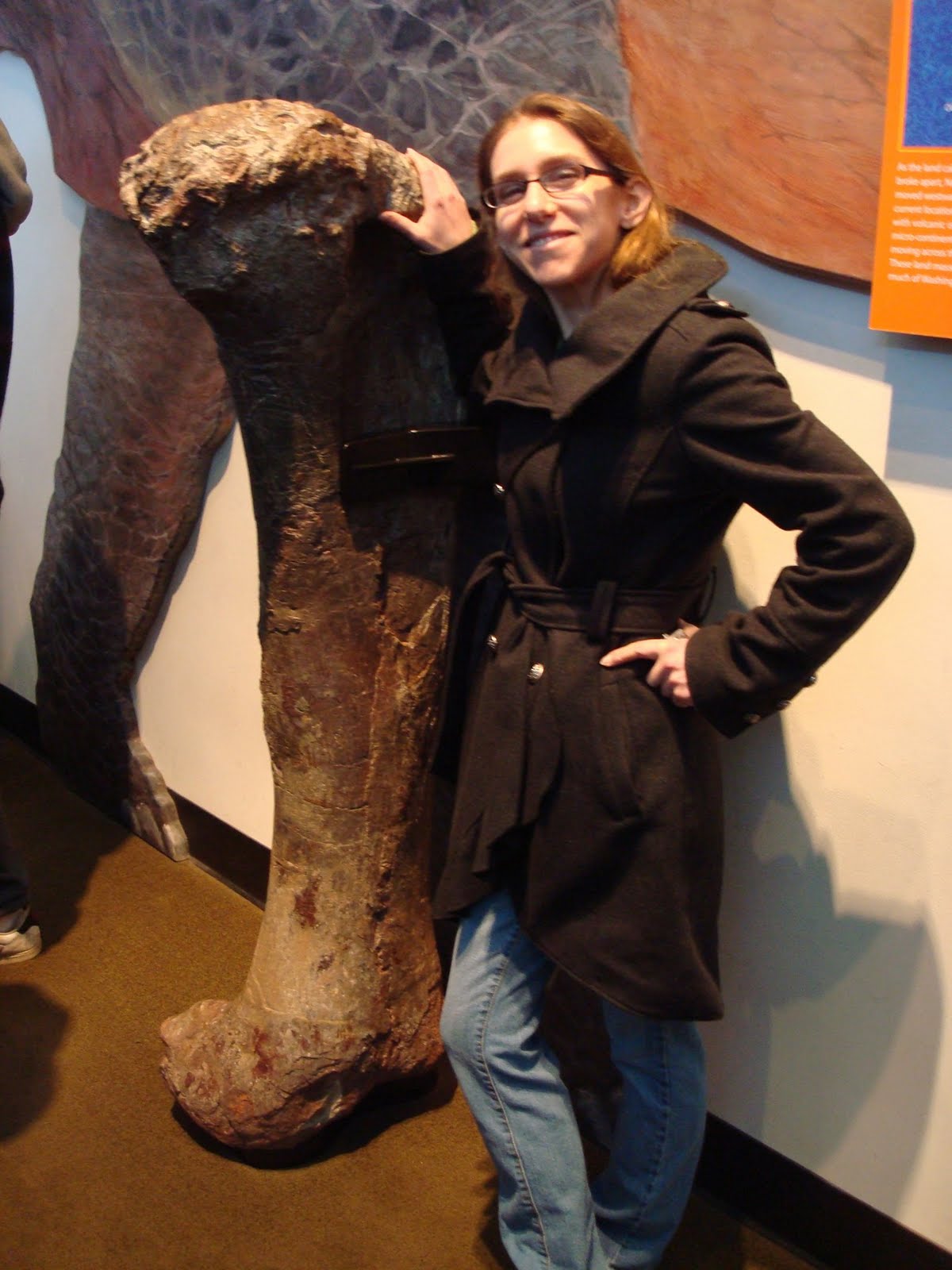
A sauropod femur is nearly as tall as I am and probably weighs more.
The replicas of dinosaur bones were so realistic that I couldn't tell which ones were genuine. Archeopteryx, an avian ancestor is called "Urvogel" in German, which is a combination of the word for "bird" and the prefix used for "first" or "great," as in "great-grandmother." This is the great-grandmother bird's fossilized remains:
You can see the elements that make this species a transition between reptiles and their flighted relations.
A mastodon skeleton loomed over an entire narrow room, so much so that I couldn't frame it properly for a photo.
Did you know that when breaking ground for Seatac airport, construction workers stumbled upon the fossilized skeleton of a giant ground sloth? Did you even know such a thing as giant ground sloths used to exist?
In life they probably looked more like this:
And the Tyco toy company, with which many children of the 1980s are familiar, would have us believe that neanderthals used giant sloths as mounts for riding and shooting each other with turret-mounted lasers, rather like this. Slowest blitzkrieg ever.
We also learned about an archeological site in eastern Washington where the ancestor of what we know today as rhinos got caught in a lava flow that essentially acted as a flash-flood fossilization. The body burned up but the lava hardened into a rhino-shaped hole around it.
You probably aren't supposed to recline in the hole, but rather inspect it scientifically. Oh well.
The final skeleton we viewed, the Terror Bird, was displayed with accompanying drawings that (I quote Alex here) "made him look more like a terror chicken." Some of these birds stood over 10 feet and weighed in at about 400 pounds.
The lower floor of the Burke Museum also houses a collection of art from native peoples from around the world, so we perused the spectacular masks and totem poles, even though they were not even tangentially related to geology.
The museum, located just off of NE 45th on the UW campus, is open to the public daily from 10am to 5pm. For up-to-date information about visiting the museum, check out the Burke Blog here.
We started our journey at the UW seismology lab, which looked a lot less like the international space station flight control room than I expected. Instead, all of the field trippers, amounting to about 20 students, wedged into the lab with only a tiny bit of breathing room.
The most advanced earthquake monitoring and recording equipment in the Northwest looks like this:
Even more interesting than (and approximately the same square footage as) the main lab was the seismology closet.
We visited the lab just a week before the 9.0 rocked Japan, so we weren't able to see any of those recordings, though they must have been absolutely incredible.
Alex and I unpacked ourselves from sardine-tin lab and walked across campus to our next stop, the Burke Museum.
Although the Burke is not an especially large museum, the use of space and quality of exhibits is exceptional. Alex's professor, who proved to be as knowledgeable about natural history as he is about geology, led us through the exhibits displaying dinosaur skeletons, fossils and other amazing prehistoric artifacts.
A sauropod femur is nearly as tall as I am and probably weighs more.
The replicas of dinosaur bones were so realistic that I couldn't tell which ones were genuine. Archeopteryx, an avian ancestor is called "Urvogel" in German, which is a combination of the word for "bird" and the prefix used for "first" or "great," as in "great-grandmother." This is the great-grandmother bird's fossilized remains:
You can see the elements that make this species a transition between reptiles and their flighted relations.
A mastodon skeleton loomed over an entire narrow room, so much so that I couldn't frame it properly for a photo.
Did you know that when breaking ground for Seatac airport, construction workers stumbled upon the fossilized skeleton of a giant ground sloth? Did you even know such a thing as giant ground sloths used to exist?
In life they probably looked more like this:
And the Tyco toy company, with which many children of the 1980s are familiar, would have us believe that neanderthals used giant sloths as mounts for riding and shooting each other with turret-mounted lasers, rather like this. Slowest blitzkrieg ever.
We also learned about an archeological site in eastern Washington where the ancestor of what we know today as rhinos got caught in a lava flow that essentially acted as a flash-flood fossilization. The body burned up but the lava hardened into a rhino-shaped hole around it.
You probably aren't supposed to recline in the hole, but rather inspect it scientifically. Oh well.
The final skeleton we viewed, the Terror Bird, was displayed with accompanying drawings that (I quote Alex here) "made him look more like a terror chicken." Some of these birds stood over 10 feet and weighed in at about 400 pounds.
The lower floor of the Burke Museum also houses a collection of art from native peoples from around the world, so we perused the spectacular masks and totem poles, even though they were not even tangentially related to geology.
The museum, located just off of NE 45th on the UW campus, is open to the public daily from 10am to 5pm. For up-to-date information about visiting the museum, check out the Burke Blog here.
Subscribe to:
Posts (Atom)